
CPT 93306 shows up constantly in cardiology billing conversations and for good reason. It represents a complete transthoracic echocardiogram with spectral and color flow Doppler which in plain terms means the full picture of how a heart is functioning, not just a partial snapshot. When a physician orders this study they are asking for a comprehensive assessment that captures structure, blood movement and hemodynamic behavior all at once. Getting the billing right on something this foundational matters enormously because cardiology practices run high volumes of these studies and even modest error rates compound into significant revenue problems over time.
The stakes are not just financial either. Incorrect echocardiogram billing creates compliance exposure that can invite audits and strain payer relationships that took years to build. Understanding CPT 93306 thoroughly not just what it is but when it applies, how to document it properly and where practices typically go wrong is one of the more valuable investments a cardiology billing team can make.
Introduction to CPT 93306 Echocardiogram
Overview of Echocardiography in Medical Practice
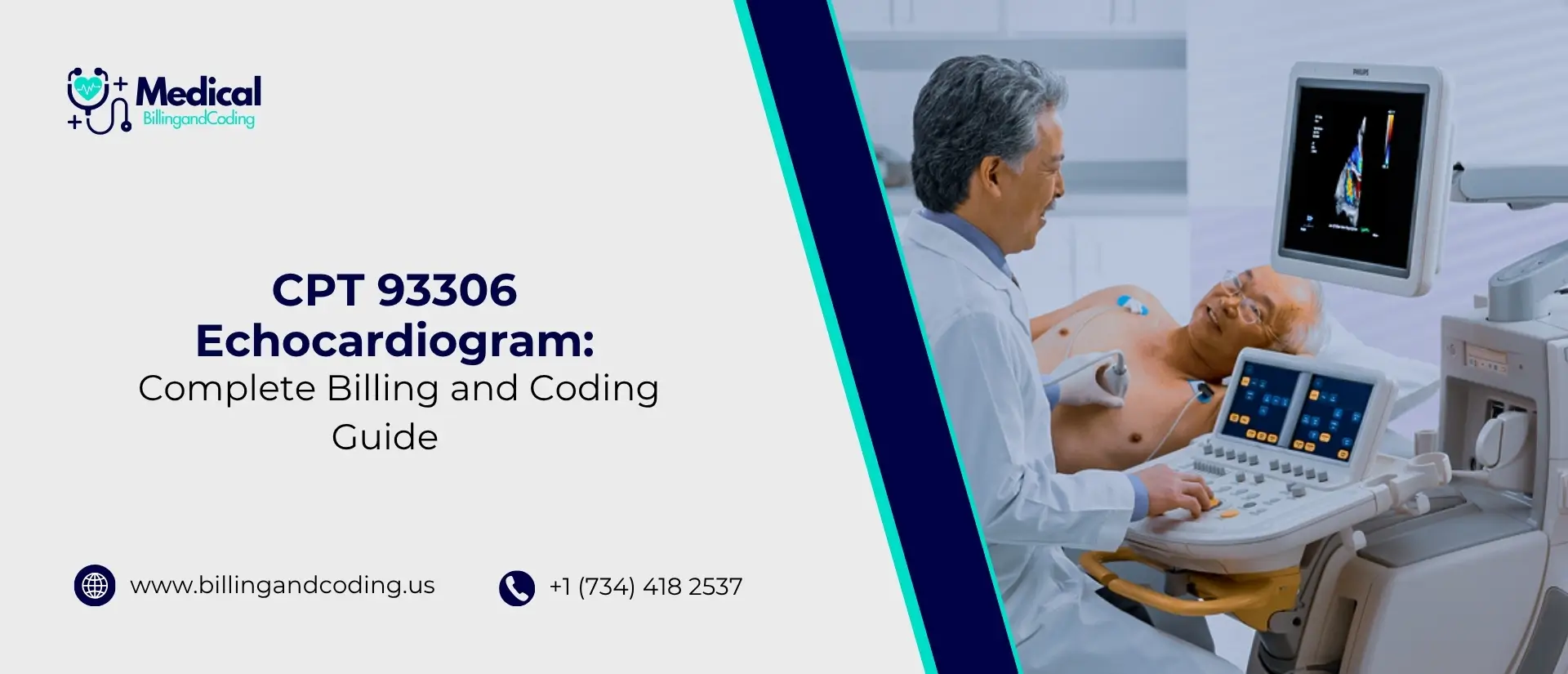
Echocardiography has become one of the most clinically relied-upon diagnostic tools in modern medicine. By directing ultrasound waves toward the chest wall and reading how those waves bounce back from cardiac structures physicians can observe the heart in motion without exposing patients to radiation or surgical risk. The technology produces real-time images of chamber dimensions, wall movement, valve function and blood flow patterns that would otherwise require far more invasive investigation.
Its reach extends well beyond cardiology departments. Emergency physicians use echocardiography to assess patients in acute distress. Hospitalists order it when new heart failure or effusion enters the differential. Primary care physicians request it for patients with unexplained shortness of breath or an abnormal ECG. The diagnostic utility is broad which is precisely why accurate coding matters so much. A test this frequently ordered generates billing volume that amplifies the consequences of any systematic error.
Why CPT 93306 Is Commonly Used
CPT 93306 occupies the position it does in cardiology coding because it represents the complete version of the most commonly ordered cardiac ultrasound study. Completeness here carries a specific technical meaning the study must include two-dimensional imaging alongside spectral Doppler and color flow Doppler. That combination provides physicians with both the structural picture and the functional data needed to make informed clinical decisions.
Because so many cardiac presentations require that level of detail CPT 93306 ends up being the default code for routine diagnostic echocardiography. A patient presenting with new heart failure symptoms is not well served by a limited study. A patient with valve disease needs Doppler data to understand the severity of the lesion. The comprehensiveness built into CPT 93306 matches the comprehensiveness that good clinical care requires which is why it dominates cardiology coding rather than being an occasional selection.
Importance of Accurate Cardiac Imaging Billing
Accurate billing in cardiac imaging is not a back-office concern that exists separately from clinical operations. When billing breaks down the effects surface quickly. Denials pile up. Revenue cycle metrics deteriorate. Staff spend time reworking claims that could have been clean on the first submission. For practices managing high echocardiogram volumes those downstream costs become substantial.
There is also the compliance dimension. Insurers and CMS pay close attention to echocardiography billing because the code is high-volume and high-value. Patterns that look like overcoding or insufficient documentation attract scrutiny. A practice that bills CPT 93306 routinely without ensuring that documentation supports each claim is building exposure over time. Getting billing right from the beginning is always less expensive than cleaning up problems after they have accumulated.
If your practice needs structured support for this kind of work physician billing services designed specifically for cardiology environments can make a meaningful difference in both accuracy and efficiency.
What is CPT Code 93306?
CPT 93306 describes a complete transthoracic echocardiogram performed with both spectral and color flow Doppler imaging. Transthoracic means the transducer is placed on the external chest wall rather than inserted into the esophagus as in a transesophageal approach. The study is non-invasive and represents the standard first-line echocardiographic evaluation for most cardiac conditions encountered in outpatient and inpatient settings alike.
The word “complete” in the code definition is doing important work. It means the study cannot consist of targeted measurements alone. The full echocardiographic protocol must be performed and the report must reflect that completeness. Practices that bill CPT 93306 for studies that were limited in scope — either by time or by the elements actually imaged — are billing incorrectly even if the order requested a complete study.
Definition of Transthoracic Echocardiogram (TTE)
A transthoracic echocardiogram is performed by placing an ultrasound transducer at specific positions on the patient’s chest and obtaining standardized cardiac views from each position. The sonographer acquires images of all four heart chambers, the major valves, the pericardium and the great vessels as they connect to the heart. Blood flow measurements are taken using spectral Doppler and color flow mapping helps visualize the direction and turbulence of flow across valves and through chambers.
The procedure requires no sedation, no radiation and no recovery time which makes it one of the most patient-friendly diagnostic tools available for cardiac evaluation. That accessibility contributes to its high utilization rate and by extension to the billing volume that practices need to manage carefully.
Components Included in CPT 93306
Three imaging components together constitute the complete study captured under CPT 93306. Two-dimensional imaging provides structural visualization of the heart. Spectral Doppler provides quantitative blood flow measurements including velocities and pressure gradients across valves. Color flow Doppler adds a visual map of flow patterns that helps identify regurgitation, stenosis and shunt pathways.
All three must be present in the study and documented in the report for CPT 93306 to be appropriate. A study that includes 2D imaging but omits Doppler evaluation is a different code. The completeness requirement is not a technicality — it reflects what the physician actually needs from the test to guide clinical decisions effectively.
Difference Between 93306 and Other Echo Codes
The echocardiography CPT family includes codes for studies of varying scope. CPT 93307 covers a complete TTE without Doppler. CPT 93308 represents a limited or follow-up study. CPT 93303 and 93304 address congenital cardiac anomalies. CPT 93312 through 93318 cover transesophageal approaches.
Selecting the wrong code from this family creates problems in both directions. Billing CPT 93306 for a study that was actually limited in scope represents overcoding. Billing a limited code for a study that was complete and included full Doppler evaluation leaves reimbursement on the table. The documentation and the code must match what was actually performed which requires billing staff to read echocardiogram reports carefully rather than defaulting to the same code reflexively.
When to Use CPT 93306
CPT 93306 applies when a physician orders a full echocardiographic evaluation and the study is performed completely with all required imaging components. The order alone is not sufficient justification. The study must be carried out as a complete examination and the report must document every element that the code’s definition requires. If any component was not obtained for technical or clinical reasons the code selection needs to reflect that limitation.
Medical Indications for Echocardiography
The clinical scenarios that generate CPT 93306 orders span a wide range of presentations. Unexplained chest pain and shortness of breath are among the most common entry points. Newly discovered heart murmurs require echocardiographic characterization. Suspected or confirmed heart failure needs structural and functional assessment. Patients with known valvular disease require periodic surveillance to track progression. Abnormal ECG findings sometimes point toward underlying structural pathology that echocardiography can confirm or exclude.
Patient Conditions That Qualify for 93306
Hypertension with suspected end-organ involvement often warrants a complete echocardiogram. Cardiomyopathy of any etiology requires baseline and follow-up structural assessment. Congenital heart disease that has been managed into adulthood continues to need echocardiographic monitoring. Post-surgical cardiac patients need follow-up imaging to assess procedural outcomes. The connecting thread across all these scenarios is that the clinical question requires comprehensive cardiac assessment rather than targeted measurement.
CPT 93306 Billing Guidelines
Billing CPT 93306 accurately requires attention at every step from order documentation through claim submission. No single step can be treated as optional because gaps at any point in the process create vulnerabilities that affect reimbursement.
Step-by-Step Billing Process
The billing process for CPT 93306 begins with the physician order which must document the clinical indication clearly. The study is then performed and images are acquired according to the complete echocardiography protocol. A cardiologist reviews and interprets the images then generates a written report describing findings and conclusions. The coder reviews that report to confirm that all elements of CPT 93306 were performed and documented. The claim is then submitted with the CPT code, any applicable modifiers and the supporting documentation that establishes medical necessity.
For practices handling high echocardiogram volume a structured approach to medical coding helps maintain accuracy at scale without creating bottlenecks in the revenue cycle.
Required Documentation for Reimbursement
Every CPT 93306 claim needs a documented physician order with a stated clinical indication. The echocardiogram report must describe the findings from all components of the study including 2D imaging spectral Doppler measurements and color flow Doppler results. A separate interpretation by a qualified physician must be present if professional and technical components are being billed separately. Claims submitted without complete reports or with reports that fail to document all required elements are routinely rejected.
Common Billing Modifiers Used with 93306
Modifier 26 applies when a physician is billing only for the professional component the interpretation and report without owning the equipment or employing the technical staff who perform the study. Modifier TC applies in the opposite scenario where a facility is billing only for the technical component. When a single provider performs and interprets the study in their own facility global billing without modifiers applies. Matching the modifier to the actual billing arrangement is essential because incorrect modifier use leads to payment allocation errors that can be difficult to untangle after the fact.
Coding Guidelines and Compliance Rules
Compliance in echocardiography billing means staying within the framework CMS and individual payers have established for when studies are covered and how they should be documented and coded.
CMS Guidelines for Echocardiography
CMS requires documented medical necessity for every echocardiogram. National Coverage Determinations and applicable Local Coverage Determinations outline which diagnoses and clinical scenarios support coverage. Ordering a complete echocardiogram without a clinical indication that meets NCD or LCD criteria creates a claim that CMS will deny regardless of how well the study was performed or documented. Providers need to verify that the indication for each study maps to covered diagnoses before the claim is submitted.
Avoiding Upcoding and Downcoding Issues
Upcoding in echocardiography typically means billing CPT 93306 for a study that was limited or that lacked full Doppler components. Downcoding means selecting a lower-level code for a study that genuinely qualified as complete. Both undermine the integrity of the billing process. Upcoding creates compliance exposure. Downcoding leaves legitimate reimbursement uncollected. The solution to both is the same code based on what the report actually documents rather than what was ordered or what the practice typically performs.
Insurance-Specific Billing Rules
Commercial payers often layer additional requirements on top of CMS guidelines. Prior authorization for elective echocardiograms is increasingly common among larger insurers. Some payers require specific diagnosis codes from an approved list before they will cover the study. Practices that skip payer-specific verification before submitting claims encounter denial patterns that are entirely preventable. Building payer policy review into the pre-authorization and billing workflow reduces these avoidable denials significantly.
Common Mistakes in CPT 93306 Billing
Missing or Incomplete Documentation
An echocardiogram report that describes findings without quantifying Doppler measurements does not fully support CPT 93306. A claim submitted without a physician order will be denied. A study interpreted without a separate physician signature when billing the professional component creates a documentation gap. These errors appear straightforward but they occur regularly in high-volume practices where speed pressures override documentation discipline.
Incorrect Modifier Usage
Billing 93306 with modifier 26 when the physician owns the equipment and employs the sonographer is incorrect. Billing globally when the interpretation is performed by a cardiologist who is contracted rather than employed is equally problematic. The modifier must reflect the actual ownership and employment arrangement not an assumption about what arrangement is typical. Getting this wrong generates partial payments or rejections that require rework and delay revenue.
Eligibility and Medical Necessity Errors
Performing an echocardiogram before verifying that the patient’s insurance covers the study under the stated indication wastes clinical resources and creates billing problems that are difficult to resolve after the fact. Medical necessity denials are among the hardest to overturn because they require clinical documentation to justify what the initial submission failed to establish. Eligibility verification and necessity confirmation before the study is performed is far less costly than appeals after a denial. Comprehensive medical credentialing and eligibility workflows support this kind of proactive approach across a practice.
Reimbursement and Payment Insights
Average Reimbursement for CPT 93306
Medicare reimbursement for CPT 93306 is calculated using the physician fee schedule and adjusted for geographic location. The global rate for a facility that both performs and interprets the study differs from the split rates when professional and technical components are billed separately. Commercial payers negotiate their own rates which may be higher or lower than Medicare depending on contract terms. Practices should review fee schedule updates annually because reimbursement rates shift and outdated assumptions about payment levels distort revenue projections.
Factors Affecting Payment Rates
The setting where the study is performed affects reimbursement meaningfully. Hospital outpatient department rates differ from freestanding cardiology office rates. Geographic adjustments under the Medicare fee schedule mean that the same CPT 93306 claim generates different payments in different parts of the country. Whether the claim is billed globally or with component modifiers affects how payment is split between the performing facility and the interpreting physician. Understanding these variables helps practices set realistic revenue expectations and identify contracts where payment levels may not adequately reflect the cost of delivering the service.
Insurance Denials and How to Prevent Them
The most effective denial prevention strategy for CPT 93306 is documentation that is complete before the claim is submitted. That means confirming the indication is covered, verifying the report includes all required elements and checking that modifier usage reflects the actual billing arrangement. Practices that run internal audits on a sample of echocardiogram claims monthly catch systematic problems early before they generate large denial volumes. For practices managing significant claim volume structured support through emergency room billing or outpatient cardiology billing services provides an additional layer of quality control.
Best Practices for Accurate Echocardiogram Billing
Improving Documentation Quality
Echocardiogram reports that follow a standardized template covering all required elements are easier to code accurately and faster to process through claims. When sonographers and interpreting cardiologists understand what documentation is needed for reimbursement — not just for clinical purposes — report quality tends to improve meaningfully. A report that clearly quantifies Doppler measurements, documents all imaging views obtained and states a clear clinical conclusion supports both accurate coding and clean claim submission.
Staff Training and Coding Accuracy
Billing staff who understand the clinical context of echocardiography make better coding decisions than staff who treat it as a mechanical matching exercise. Training that explains what a complete echocardiogram actually involves why Doppler components matter to code selection and how report language connects to billing accuracy gives coders the foundation to identify problems before claims are submitted rather than after they are denied.
Using Technology for Claim Submission
EHR and billing software platforms that are configured for cardiology workflows reduce manual errors at the coding and submission stages. Automated eligibility checks catch coverage problems before studies are performed. Coding assistance tools that flag incomplete reports before claim submission prevent denials that would otherwise require rework. Real-time claim status tracking allows billing teams to identify stuck claims quickly rather than discovering unpaid work weeks after the service date.
Conclusion
CPT 93306 sits at the intersection of clinical cardiology and billing complexity. Getting it right requires understanding not just the code definition but the documentation standards, modifier rules, payer requirements and compliance framework that surround it. Practices that invest in that understanding through staff training, workflow improvements and accurate documentation habits see the return in cleaner claims, fewer denials and reimbursement that reflects the real value of the diagnostic work being done. The technical demands of echocardiography billing are manageable. What makes the difference is treating them with the same rigor that the clinical work itself deserves.
Make An Appintment With Us