

Introduction
Few codes show up as consistently across clinical settings as CPT 36415. Walk into almost any outpatient clinic, hospital lab or physician office and chances are this code was billed before noon. It represents something that seems deceptively simple on the surface — a routine venipuncture, or blood draw — yet the billing rules surrounding it trip up even seasoned coders more often than they should. The code itself covers the collection of venous blood for laboratory testing purposes. It does not touch the cost of the test being run. Just the draw. That distinction alone is the source of a surprising number of billing errors.
Introduction to CPT Code 36415
What is CPT Code 36415?
CPT 36415 captures one specific clinical action: inserting a needle into a vein and collecting blood for diagnostic purposes. Nothing more is bundled into that description. The laboratory work that follows, whether that is a metabolic panel, a lipid screen or a complete blood count, is billed entirely separately under its own set of codes. This separation matters because providers sometimes assume the draw fee is implicit in the lab order. With certain payers it is. With others it is a separately reimbursable service. Treating both scenarios the same way is where the billing problems begin.Importance of Proper Blood Draw Billing in Medical Coding
Billing accuracy for venipuncture is about more than collecting a modest fee. It reflects the integrity of a practice’s entire revenue cycle. Blood draws require trained personnel, sterile supplies, proper specimen handling protocols and time. That clinical work deserves accurate recognition through the billing process. When CPT 36415 is routinely misbilled — whether through bundling errors, missing documentation or duplicate submissions — the financial impact compounds over time. High-volume labs and outpatient practices billing dozens of draws per day feel this acutely. Even small per-claim losses at that volume add up to meaningful revenue leakage across a billing period. Practices that invest in precise coding workflows, like those supported through professional medical coding services, tend to catch these patterns early before they settle into costly habits.Why CPT 36415 is Common in Laboratory Services
Blood testing is one of the most ordered diagnostic services in all of medicine. Annual wellness visits, pre-operative clearance, chronic disease management, pregnancy monitoring, infection workups — nearly every patient encounter that involves a clinical decision also involves a lab order at some point. That reality makes CPT 36415 one of the most frequently appearing codes across specialties, not just in standalone labs but in primary care, endocrinology, oncology and beyond.Understanding Routine Venipuncture (Blood Draws)
What is Venipuncture?
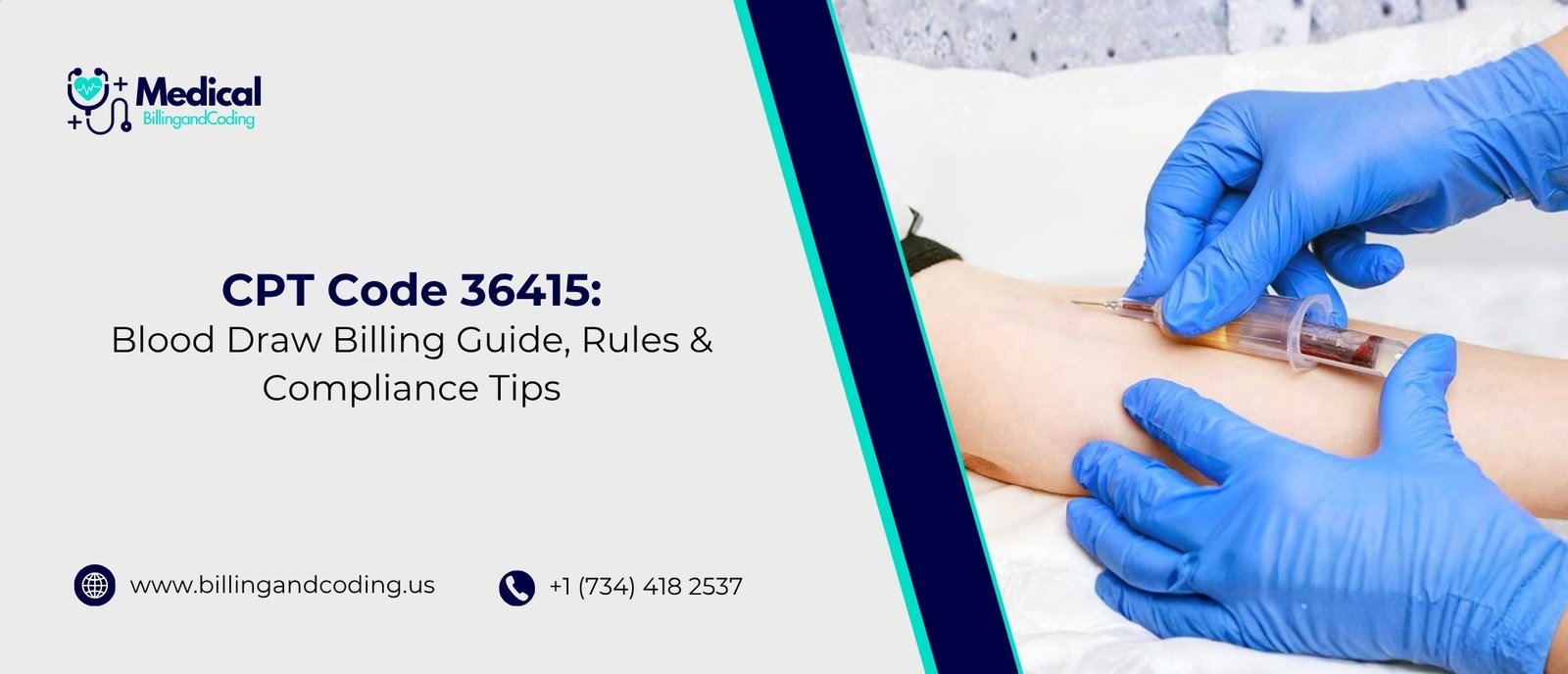
Venipuncture is the clinical procedure of puncturing a vein with a needle to obtain a blood sample. The antecubital fossa, the soft area inside the elbow, is the most commonly used site though skilled phlebotomists may also draw from the forearm, hand or wrist when anatomy requires it. Done correctly it takes under a minute and leaves little more than a small bruise at worst. Done incorrectly it can cause hematoma formation, nerve irritation, specimen hemolysis that invalidates the sample entirely or patient injury that creates liability exposure for the facility. The procedural simplicity is real but it does not make the skill requirement trivial.When is a Routine Blood Draw Performed?
The range of situations that call for venipuncture is broad enough that listing them exhaustively would be its own article. Practically speaking, a blood draw is performed whenever a provider needs laboratory data to inform a clinical decision. That includes annual physical exams where baseline labs are obtained, pre-surgical screening for coagulation and metabolic status, ongoing monitoring for patients managing diabetes, thyroid disorders or cardiovascular conditions and acute diagnostic workups where a provider needs to rule in or out infection, anemia, organ dysfunction or electrolyte imbalance.Role of CPT 36415 in Clinical Practice
The code functions as the billing representation of the technical collection service. It tells the payer that a qualified individual performed a venipuncture procedure on a specific date for a specific patient. Paired with the appropriate laboratory CPT codes and diagnosis codes, it creates a complete billing picture that payers can adjudicate. The clinical team handles the procedure. The billing team translates it into a claim. CPT 36415 is the bridge between those two functions.Billing Guidelines for CPT Code 36415
When to Bill CPT 36415 Separately
Separate billing for CPT 36415 is appropriate when the blood draw is performed as a standalone service and the payer’s guidelines permit it. Not all payers do. Some commercial insurers bundle the venipuncture fee into the reimbursement for the lab panel ordered. Medicare has its own specific conditions under which the code is separately payable. Medicaid varies considerably from state to state. The practical takeaway is that payer verification before claim submission is not a step that can be skipped. Assuming the same rules apply across all payers is one of the more common and more avoidable mistakes in lab billing.Services Included in the Code
CPT 36415 covers the venipuncture procedure itself along with the supplies directly associated with the collection such as needles, collection tubes, tourniquets and specimen labels. It also includes the basic specimen handling that occurs between collection and transport to the laboratory. What it does not include is the analytical work performed on the sample once it reaches the lab. That component is captured through entirely separate CPT codes.Common Billing Mistakes to Avoid
The most persistent billing mistakes with CPT 36415 follow a recognizable pattern. Billing it separately when the payer has already bundled it into the lab fee results in a claim that looks like a duplicate to the payer even if it was submitted in good faith. Failing to document the procedure adequately leaves the claim vulnerable during audit review. Submitting multiple venipuncture codes for a single draw session without medical justification triggers payer scrutiny almost immediately. Each of these errors is preventable with the right coding oversight in place.Documentation Requirements for CPT 36415
What Must Be Documented in Patient Records
The clinical record needs to clearly reflect that a venipuncture took place. That means documenting the date and time of the procedure, the clinical reason the draw was ordered, the site used and the identity of the person who performed the collection. This documentation does not need to be elaborate but it does need to exist and it does need to be specific enough to withstand a payer review.Proof of Venipuncture Procedure
Acceptable proof includes physician or nursing notes referencing the blood draw, lab requisition forms tied to the encounter date, or electronic health record entries that log the collection event. In practices using integrated EHR and billing platforms, this documentation often generates automatically when the phlebotomist marks the collection as complete. Even so, periodic audits of that documentation are worthwhile because automated entries sometimes lack the clinical detail payers expect.Insurance and Compliance Considerations
Payers expect documentation to support every code on a claim. For CPT 36415 that means the record must substantiate that venipuncture occurred, was medically warranted and was performed by a qualified individual. CMS guidelines and individual payer contracts may impose additional specificity requirements. Practices that operate without a consistent documentation standard create compliance gaps that become apparent quickly when claims are audited.CPT 36415 Reimbursement Guidelines
How Insurance Pays for Blood Draws
Reimbursement for CPT 36415 varies considerably by payer type and contract terms. Some commercial insurers pay a flat rate per encounter regardless of how many tubes were collected. Others apply a fee schedule that differs based on the setting where the draw occurred. Hospital-based outpatient labs often receive different rates than freestanding reference labs performing the same collection service.Medicare and Medicaid Rules for CPT 36415
Medicare reimburses CPT 36415 as a separately payable service under certain conditions, particularly when the draw is performed in a non-facility setting and is not already included in a bundled global fee. Medicaid policies are state-specific and can differ significantly even for identical clinical scenarios. Providers billing across state lines or serving dual-eligible patients need to be especially attentive to which set of rules governs each claim.Factors That Affect Payment Rates
Geographic payment localities, provider type, facility versus non-facility settings and individual payer contracts all influence what CPT 36415 actually pays on any given claim. In high-volume labs this variability has direct revenue implications. Monitoring payment rates by payer and reconciling them against contracted rates is a standard component of competent revenue cycle management. The team at billingandcoding.us works with practices to navigate exactly these kinds of payer-specific complexities.Common Errors in Billing CPT Code 36415
Unbundling Issues with Lab Services
Unbundling occurs when a provider submits CPT 36415 as a separate line item on a claim where it is already included in the reimbursement for a lab panel. Some laboratory panels have the collection fee embedded in their payment by certain payers. Billing the venipuncture on top of that creates an overpayment situation that payers will catch and recover, sometimes with interest and sometimes with additional scrutiny applied to future claims from the same practice.Duplicate Billing Problems
A single blood draw session should generate a single CPT 36415 claim regardless of how many individual tubes were collected or how many different tests were ordered from that draw. The only scenario where multiple venipuncture codes are appropriate is when genuinely separate draw events occurred at different times during the same encounter and that distinction is clearly supported by documentation. Absent that justification, duplicate venipuncture billing is an error that payers flag consistently.Missing or Incomplete Documentation
Incomplete documentation is the most fundamental billing problem across all of medical coding and CPT 36415 is no exception. A claim without supporting records behind it is a claim that cannot survive scrutiny. Whether the gap is a missing procedure note, an unsigned lab requisition or an EHR entry that lacks clinical context, the result is the same: a denial that requires rework and delays reimbursement.Best Practices for Accurate Billing
Proper Coding Workflow for Lab Services
A structured coding workflow starts before the patient leaves the draw chair. Collection events should be logged in real time, tied to a specific encounter and linked to the orders that justified the draw. The billing team should have a clear process for verifying payer rules before submitting venipuncture claims and a systematic method for reconciling remittance against expected payment rates. Practices that build these workflows from the ground up, rather than patching them together reactively after denials, consistently outperform their peers in clean claim rates and days in accounts receivable.Staff Training for Correct CPT Usage
Even a well-designed billing system breaks down when the people using it do not fully understand what CPT 36415 covers, when it applies and when it does not. Training should cover the difference between venipuncture and capillary collection, the bundling rules that apply to the payers most frequently billed, documentation standards for the code and the scenarios that most commonly lead to denials. This training should not be a one-time event. Coding guidelines change and payer policies update with enough regularity that annual refreshers at minimum are warranted.Using Medical Billing Software Effectively
Modern billing platforms offer functionality that directly reduces CPT 36415 errors when configured properly. Bundling edits can flag claims where venipuncture is already included in a lab panel payment. Duplicate claim checks prevent the same draw from being billed twice. Documentation prompts can remind clinical staff of what needs to be captured before the encounter closes. These tools are only as effective as the people configuring and monitoring them but in a high-volume lab environment they provide a meaningful layer of protection against the errors that accumulate into serious revenue problems.Frequently Asked Questions about CPT Code 36415
CPT Code 36415 covers the routine collection of venous blood through venipuncture. It only includes the act of drawing blood and does not include laboratory testing or analysis of the sample.
Yes, CPT 36415 can be billed along with other lab tests if payer guidelines allow it. However, some insurance companies bundle it into lab panels, so it is important to check specific billing rules before submitting claims.
No, CPT 36415 is strictly for venous blood draws (venipuncture). Finger sticks or capillary blood collection procedures are billed under different codes or may not be separately reimbursed.
CPT 36415 can be performed by trained healthcare professionals such as phlebotomists, nurses, or lab technicians who are qualified to perform venipuncture procedures.
Denials often occur due to bundling rules, missing documentation, duplicate billing, or payer-specific policies that include venipuncture in a global lab fee.
Yes, Medicare does reimburse CPT 36415 when it is billed correctly and meets medical necessity requirements. However, reimbursement may vary based on local coverage determinations.
Billing errors can be avoided by following payer guidelines, ensuring complete documentation, avoiding duplicate claims, and using proper coding workflows and billing software.