
Medical coding is rarely as straightforward as it looks from the outside. For every diagnosis a provider documents, a coder must trace that clinical language back to a precise alphanumeric string one that a payer will accept, process and reimburse without dispute. E78.5 is one of those codes that appears frequently across primary care, cardiology and internal medicine, yet still generates confusion when documentation is vague or when coders default to it without examining whether a more specific code applies.
Definition of E78.5
E78.5 is the ICD-10-CM code for hyperlipidemia, unspecified. It falls under the broader category of lipoprotein metabolism disorders and other lipidemias, which are grouped within Chapter 4 of ICD-10-CM covering endocrine, nutritional and metabolic diseases. The "unspecified" designation is the defining characteristic of this code it signals that the provider's documentation identifies an elevated lipid level but does not specify whether the abnormality involves cholesterol, triglycerides, or a combination of both.
That distinction matters more than it might initially seem. The ICD-10-CM classification system for lipid disorders is built around specificity and E78.5 occupies the lowest rung of that specificity ladder. It is valid and billable, but it should only be selected when the clinical record genuinely does not support a more defined code.
Conditions Covered Under E78.5
E78.5 serves as a catch-all for elevated lipid states that resist more precise classification. It may apply when a provider notes hyperlipidemia in the problem list without specifying the type, when lab results show abnormal lipid panels without a clear pattern of pure hypercholesterolemia or pure hypertriglyceridemia, or when a patient is managed on lipid-lowering therapy and the underlying lipid profile has not been recently restated in the documentation.
Conditions that might resolve into more specific codes upon further documentation include isolated high LDL cholesterol, elevated triglycerides without accompanying cholesterol abnormalities and combined elevations that meet criteria for mixed hyperlipidemia. When those distinctions are clearly captured in the record, E78.5 is no longer the right choice.
Why Accurate Coding Matters
The downstream consequences of imprecise coding reach further than most providers realize. Payers use diagnosis codes not just to process individual claims but to build risk profiles, authorize services and determine coverage for related treatments. A patient coded repeatedly with E78.5 when their condition is actually mixed hyperlipidemia may face coverage gaps when they need specialist care or when prior authorization for a high-intensity statin is required.
From a revenue cycle perspective, specificity protects the practice. Accurate coding through professional medical coding services reduces audit exposure, supports medical necessity for associated services and prevents the payer from questioning whether the level of care was justified. Unspecified codes do not automatically trigger denials, but they invite scrutiny particularly in high-volume chronic disease management.
Understanding Hyperlipidemia and E78.5
What Is Hyperlipidemia?
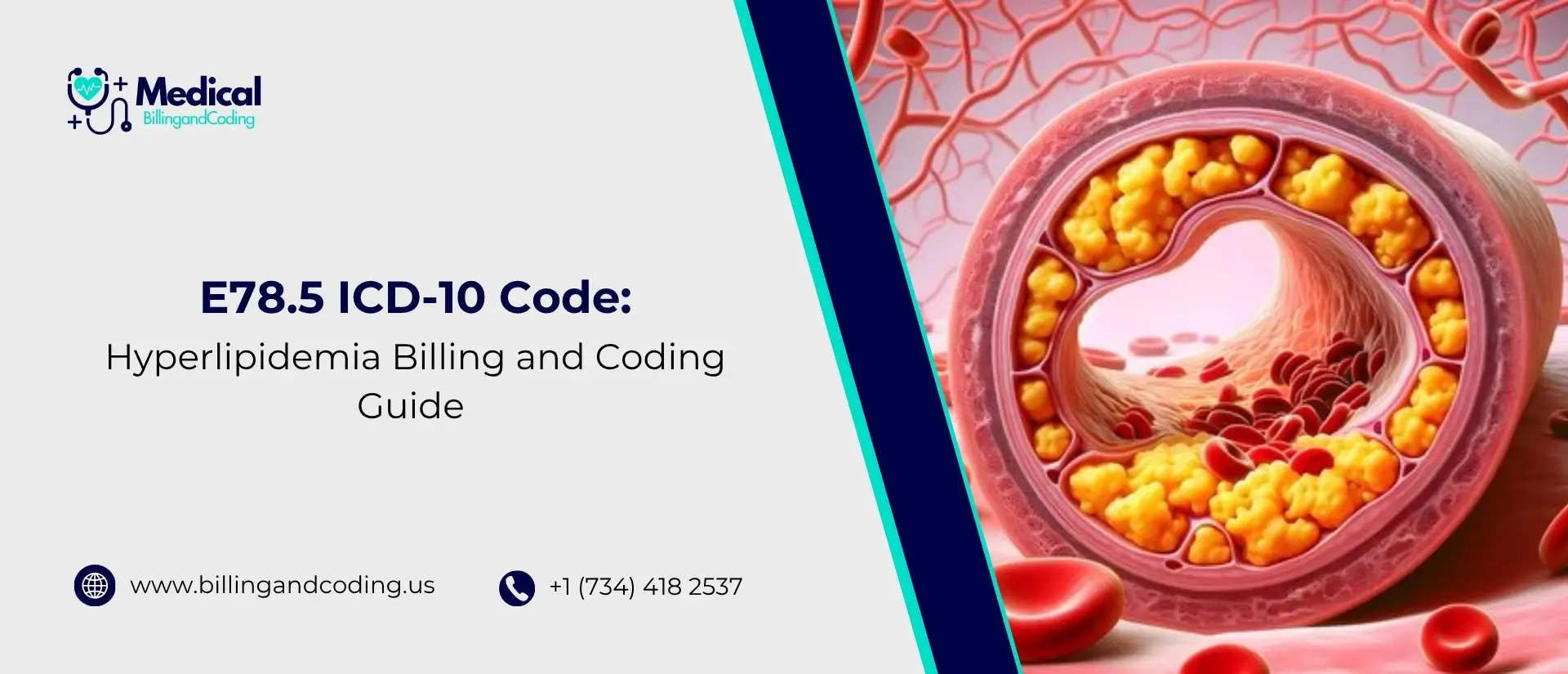
Hyperlipidemia describes a group of metabolic conditions characterized by elevated concentrations of lipids — primarily cholesterol and triglycerides in the bloodstream. Lipids themselves are not inherently harmful. They serve essential biological functions, including cell membrane construction, hormone synthesis and energy storage. The problem arises when concentrations exceed thresholds associated with cardiovascular risk, particularly when LDL cholesterol accumulates in arterial walls and contributes to atherosclerotic plaque formation.
The clinical category of hyperlipidemia is broad enough to encompass several distinct subtypes. Some patients present with isolated elevations in total cholesterol or LDL. Others show primarily elevated triglycerides. Still others present with mixed patterns involving both. The ICD-10-CM code set reflects these distinctions, which is precisely why E78.5 the unspecified variant should not be the default selection when the clinical picture is more defined.
Common Causes and Risk Factors
Hyperlipidemia develops through a combination of genetic predisposition and lifestyle factors. Familial hypercholesterolemia, a hereditary condition that impairs LDL clearance from the bloodstream, can produce severely elevated cholesterol levels even in patients who maintain healthy diets and exercise regularly. This form of hyperlipidemia often requires more aggressive pharmacological management and carries higher cardiovascular risk at younger ages.
More commonly, hyperlipidemia develops in the context of diet high in saturated and trans fats, physical inactivity, obesity and metabolic syndrome. Hypothyroidism, type 2 diabetes, chronic kidney disease and certain medications including corticosteroids, thiazide diuretics and some antipsychotics can also drive lipid abnormalities as secondary effects. When hyperlipidemia arises secondary to another condition, coders must sequence the codes appropriately, placing the underlying condition first.
Symptoms and Clinical Significance
Hyperlipidemia is largely asymptomatic until it produces structural consequences. Patients do not feel elevated cholesterol. They do not experience pain or dysfunction that signals abnormal triglyceride levels at least not until those levels become extreme or plaque formation produces ischemic events. This clinical silence is what makes routine lipid screening so important and what gives the diagnosis code so much weight in chronic disease documentation.
In severe or long-standing cases, physical manifestations can include xanthomas (fatty deposits under the skin), xanthelasmas (cholesterol deposits around the eyelids) and corneal arcus in younger patients. Extremely elevated triglycerides carry risk of acute pancreatitis. For most patients, though, the clinical significance of hyperlipidemia is its role as a modifiable cardiovascular risk factor one that, when well-managed, significantly reduces the probability of myocardial infarction and stroke.
When to Use the E78.5 ICD-10 Code
Appropriate Clinical Scenarios
E78.5 is appropriately applied when a provider documents hyperlipidemia without specifying its composition, when lab results indicate abnormal lipids but the documentation does not characterize the pattern with enough detail to support a more specific code, or when the diagnosis appears in a patient's medical history without accompanying clinical description.
It is also appropriate as a secondary code in encounters where hyperlipidemia is an active comorbidity being managed alongside a primary diagnosis. A patient presenting for a cardiovascular risk assessment, for example, may carry E78.5 as a secondary code if hyperlipidemia is listed among their active conditions and is being addressed during the visit.
Documentation Requirements
The documentation must support whatever code is selected. For E78.5, that means the provider must have noted the presence of hyperlipidemia either as an active diagnosis, a chronic condition, or a clinically relevant finding — somewhere in the encounter note. The code cannot be inferred from a lab value alone without a corresponding physician interpretation or diagnosis statement.
Providers who document "elevated lipids" or "abnormal lipid panel" without stating a diagnosis create ambiguity that places the coder in a difficult position. Querying the provider for clarification is the appropriate step when documentation is insufficient rather than selecting E78.5 by assumption. Medical billing services that include clinical documentation review help practices catch these gaps before they affect claim outcomes.
Coding Guidelines for E78.5
ICD-10-CM Official Guidelines instruct coders to code to the highest degree of specificity supported by the medical record. E78.5 satisfies that requirement only when the record genuinely does not support a more specific lipid disorder code. When a provider's note clearly describes elevated LDL cholesterol without triglyceride involvement, E78.00 or E78.01 may be more appropriate. When both cholesterol and triglycerides are elevated, E78.2 for mixed hyperlipidemia deserves consideration.
Coders should also consider whether hyperlipidemia is the primary reason for the encounter or a secondary condition. Sequencing affects how the claim is read by the payer and can influence medical necessity determinations for related services. Never assign E78.5 as the principal diagnosis for an encounter where a more acute or specific condition drove the visit unless hyperlipidemia itself was the primary reason for the appointment.
Medical Billing Considerations for E78.5
Claim Submission Best Practices
Clean claim submission for encounters involving E78.5 starts with aligning the diagnosis code to the services billed. If a provider conducts a comprehensive metabolic workup during the visit, the documentation should reflect the clinical rationale for each service ordered and the role that the lipid disorder played in the clinical decision-making. This supports medical necessity for the associated CPT codes and reduces the risk of payer pushback.
Claims involving E78.5 as a primary or secondary diagnosis should also be reviewed for any required prior authorization. While routine lipid management visits typically do not require advance approval, specialist referrals, advanced diagnostic testing, or high-cost medications initiated during the encounter may trigger authorization requirements depending on the payer and plan. Accurate payment posting services paired with a diligent pre-authorization workflow ensure that nothing falls through the cracks after the claim is adjudicated.
Common Billing Errors to Avoid
One of the most frequent billing errors involving E78.5 is using it as the default lipid code without reviewing whether a more specific code applies. Coders who default to unspecified codes as a matter of habit are leaving specificity on the table and increasing audit risk. Payers tracking coding patterns across a provider's claims will notice when unspecified codes appear at rates that exceed clinical justification.
Another common error is failing to update chronic condition codes when the patient's lipid profile has changed. A patient initially coded with E78.5 whose subsequent documentation clearly identifies mixed hyperlipidemia should have their code updated accordingly. Carrying an outdated unspecified code forward across multiple encounters suggests poor documentation practices and can complicate prior authorization for more intensive therapies.
Bundling errors also occur when coders fail to recognize that certain lab services billed alongside an E78.5 diagnosis may be subject to payer-specific bundling edits. Reviewing the CPT-to-ICD pairing for lipid panel codes against payer-specific policies prevents remittance surprises.
Insurance Reimbursement Considerations
Reimbursement for encounters involving E78.5 depends on the E/M level billed, the complexity of medical decision-making documented and any associated services. The lipid disorder diagnosis itself does not determine reimbursement it contextualizes the encounter. What payers evaluate is whether the services billed are medically necessary given the documented diagnoses and clinical presentation.
Some plans impose restrictions on reimbursable lipid testing frequency. A patient whose lipid panel was tested three months ago may face a coverage denial for a repeat panel unless clinical documentation explains the rationale for retesting a change in medication, new symptoms, or a cardiovascular event. The diagnosis code alone does not resolve that question. The clinical note must carry the argument.
ICD-10 Codes Related to E78.5
E78.0 Pure Hypercholesterolemia
E78.0 covers pure hypercholesterolemia an elevation in cholesterol without a corresponding triglyceride abnormality. Within this subcategory, ICD-10-CM offers additional specificity. E78.00 represents pure hypercholesterolemia, unspecified useful when the provider notes high cholesterol without identifying the specific lipoprotein subtype. E78.01 identifies familial hypercholesterolemia, which carries distinct clinical implications and may affect coverage determinations for PCSK9 inhibitors and other high-intensity treatments.
E78.1 Pure Hyperglyceridemia
E78.1 applies when elevated triglycerides are the primary lipid abnormality and cholesterol levels are within normal range. This distinction matters clinically because pure hypertriglyceridemia at severe levels carries pancreatitis risk and may be managed with different pharmacological agents than cholesterol-predominant disorders. Billing E78.5 when documentation clearly supports E78.1 represents a missed opportunity for coding specificity.
E78.2 Mixed Hyperlipidemia
E78.2 captures the patient whose lipid profile shows concurrent elevations in both cholesterol and triglycerides. This is one of the more clinically common presentations in primary care, particularly among patients with metabolic syndrome and it is frequently undercoded as E78.5 when providers document "high cholesterol and triglycerides" without explicitly using the term mixed hyperlipidemia. Coders familiar with clinical terminology can often support E78.2 from documentation that describes the lipid pattern without using that exact phrase.
Differences Between Related Lipid Disorder Codes
The distinction between these codes is not just a coding technicality it reflects clinically meaningful differences in pathophysiology, treatment approach and cardiovascular risk stratification. E78.5 should not function as a substitute for E78.0, E78.1, or E78.2 when the documentation supports one of those more specific options. Using the correct code communicates the patient's actual condition to payers, specialists and quality reporting systems.
Documentation Tips for Healthcare Providers
Essential Elements in Patient Records
Every encounter note involving hyperlipidemia should include a clear diagnosis statement that goes beyond "elevated lipids." Providers should state the type of lipid abnormality when known, reference current or recent lab values, describe any treatment being administered and note the patient's response to that treatment. When a patient is on a statin, the note should identify the medication and the clinical reason for its use.
For patients with familial hypercholesterolemia, documentation should reference the hereditary component. For patients with secondary hyperlipidemia driven by another condition, the primary condition should be clearly identified and sequenced first in the problem list.
Supporting Medical Necessity
Medical necessity documentation for hyperlipidemia-related services rests on connecting the diagnosis to the clinical decisions made during the encounter. If a provider orders a comprehensive lipid panel, the note should explain why the test was clinically indicated at that point in the patient's care. If a new medication is initiated or an existing one is adjusted, the documentation should reflect the clinical reasoning including lab trends, cardiovascular risk factors and treatment goals.
Payers evaluating claims for lipid management services want to see that the diagnosis drove the clinical activity. A note that lists hyperlipidemia in the problem list but makes no further reference to it in the assessment and plan creates a documentation gap that billing teams should flag for clarification before submission.
Audit and Compliance Considerations
Hyperlipidemia is a high-prevalence chronic condition, which means it appears on a significant volume of claims and draws proportional audit attention. OIG work plans and commercial payer audits periodically target chronic disease coding practices, looking for patterns of upcoded E/M services supported by thin documentation or unspecified diagnosis codes used where specific ones apply.
Practices should conduct periodic internal coding audits on encounters involving E78.5 to confirm that the unspecified code is appropriate in each instance and that documentation supports the E/M level billed. When audits reveal systemic documentation gaps, provider education is more effective than retroactive claim correction.
Common Challenges in Coding E78.5
Selecting the Correct Diagnosis Code
The most persistent challenge with E78.5 is the tendency to apply it reflexively rather than analytically. Coders under production pressure may default to the unspecified code to keep the workflow moving, particularly when provider documentation is ambiguous. But that habit, compounded across hundreds of claims, creates a pattern that does not reflect the actual clinical complexity of the patient population.
Building a query process into the coding workflow where ambiguous documentation triggers a provider query before the code is finalized is the most effective structural solution. Queries should be specific, reference the relevant clinical detail and offer the provider clear options for responding.
Handling Unspecified Diagnoses
Unspecified codes like E78.5 are not inherently wrong. ICD-10-CM includes them precisely because clinical documentation is sometimes incomplete and coding must reflect reality rather than impose false precision. The challenge is distinguishing between legitimate use of an unspecified code and habitual use driven by documentation gaps that could be corrected.
When providers consistently document hyperlipidemia without specifying type, the solution is education rather than coding workarounds. Helping providers understand how their documentation choices affect coding specificity, reimbursement and quality metrics creates more sustainable improvements than adjusting codes after the fact.
Preventing Claim Denials
Denials tied to E78.5 most often arise from mismatches between the diagnosis and the services billed, from missing documentation of medical necessity, or from eligibility issues unrelated to the diagnosis code itself. A structured pre-submission review that checks diagnosis-to-procedure alignment, confirms supporting documentation is in place and verifies payer-specific requirements for the services billed reduces denial rates without requiring significant additional staff time.
Conclusion
E78.5 is a useful code in the right circumstances, but it is too often used as a shortcut rather than a deliberate clinical coding decision. Medical billers and coders working with hyperlipidemia diagnoses should understand the full landscape of related codes in the E78 category, build query workflows that resolve documentation ambiguity before coding is finalized and audit E78.5 usage periodically to confirm it is being applied appropriately across the practice.
Make An Appintment With Us