

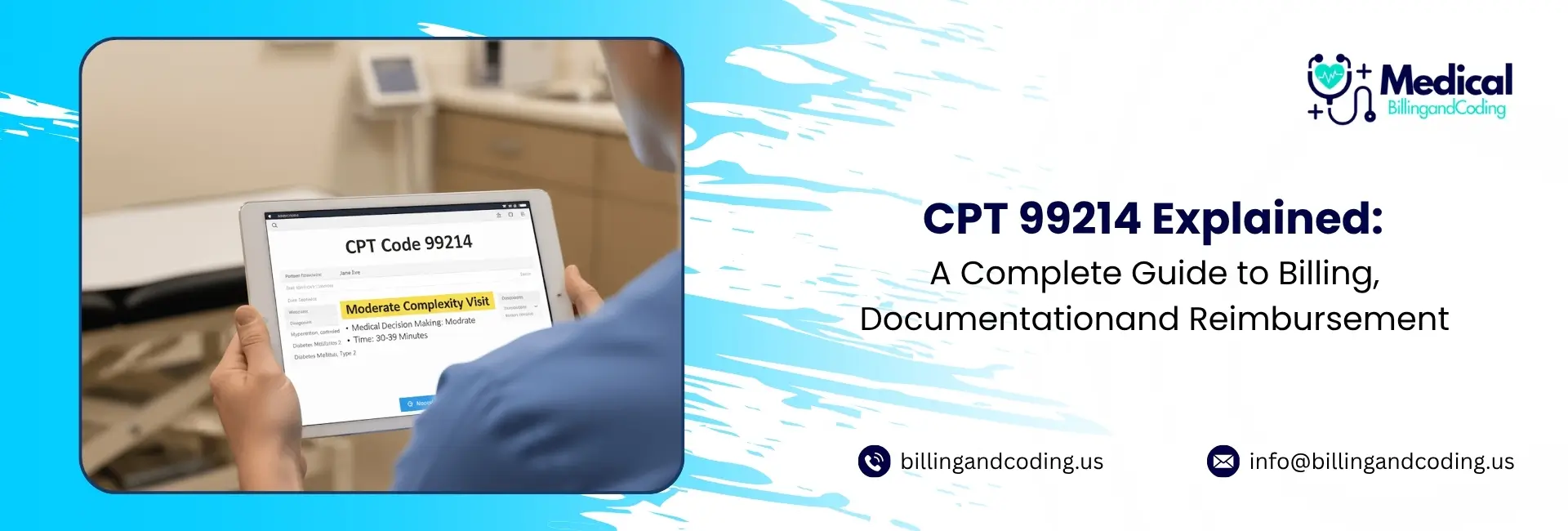
CPT code 99214 is one of the most frequently billed evaluation and management codes in outpatient medicineand also one of the most commonly denied when documentation falls short of what payers expect. For an established patient office visit involving moderate complexity, getting this code right affects both compliance and revenue in a direct, measurable way. This guide breaks down what 99214 covers, how to document it correctlyand what to do when a claim comes back denied.
What CPT code 99214 covers
CPT 99214 describes an office or other outpatient visit for an established patient, requiring a medically appropriate history and examination along with moderate level medical decision making. It sits at level 4 within the five-tier established patient E/M code family (99211 through 99215), one step below the highest complexity code, 99215.
Providers typically use 99214 for patients managing multiple chronic conditions, a new problem with an uncertain diagnosis, or an existing condition that has worsened since the last visit. A patient returning for hypertension management who also mentions new joint pain requiring workup would likely qualify. A patient coming in for a routine blood pressure check with no new complaints usually would not, since that scenario more often fits 99213.
99214 CPT code description and RVU basics
The American Medical Association assigns 99214 a work relative value unit (wRVU) of 1.92, reflecting roughly 25 to 30 minutes of physician effort and skill involved in the encounter. This work RVU combines with practice expense and malpractice RVUs to produce a total RVU figure that payers use to calculate reimbursement.
For 2026, CMS lists a non-facility total RVU of 4.06 for 99214 and a facility total RVU of 2.53. The gap between those two numbers exists because Medicare assumes a physician’s office carries overhead costs (staff, equipment, rent) that a hospital-owned facility does not bear the same way for billing purposes.
Medicare calculates payment using this formula:
(Work RVU × Work GPCI) + (Practice Expense RVU × PE GPCI) + (Malpractice RVU × MP GPCI) = Total Adjusted RVUs
Total Adjusted RVUs are then multiplied by the annual conversion factor to produce the payment amount. For 2026, CMS set two separate conversion factors for the first time in the program’s history: $33.4009 for providers not participating in a qualifying alternative payment model (non-QP)and roughly $33.57 for QP-participating providers. That split stems from statutory updates under recent budget legislation, including a one-time 2.5 percent increase tied to a 2025 spending bill.
Documentation requirements for a 99214 visit
Since the 2021 overhaul of E/M coding guidelines, providers select an office visit level using one of two methods: medical decision making (MDM) or total time spent on the date of the encounter. Neither method requires the old history and exam bullet-point counting that defined E/M coding for decades before that.
Medical decision making criteria
To support 99214 through MDM, a visit needs to meet or exceed two of these three elements at the moderate level:
- Number and complexity of problems addressed: one chronic illness with exacerbation or progression, two or more stable chronic illnesses, an undiagnosed new problem with uncertain prognosis, an acute illness with systemic symptoms or an acute complicated injury.
- Amount and complexity of data reviewed and analyzed: ordering or reviewing multiple tests, independently interpreting a test performed by another provider or discussing management with an external physician or other source.
- Risk of complications, morbidity, or mortality: prescription drug management is the most common qualifier here, but it also includes decisions about minor surgery with risk factors or diagnosis or treatment significantly limited by social determinants of health.
Prescription drug management alone often carries a visit into moderate risk territory, which is why so many chronic disease follow-ups land at 99214 rather than 99213.
Time-based billing option for 99214
Under the current time-based framework, 99214 corresponds to 30 to 39 minutes of total time on the date of the encounter. Total time includes preparing to see the patient, obtaining history, performing the exam, counseling, ordering tests, documenting the visitand coordinating care, not just the minutes spent face to face in the exam room.
Providers who rely on time as the deciding factor need documentation that reflects actual time spent, not an estimate applied after the fact. Auditors specifically look for a stated time range or total minutes documented somewhere in the note.
99214 vs 99213: how to tell them apart
The distinction between these two codes causes more billing errors than almost any other decision in outpatient E/M coding. The table below outlines the practical difference.
| Factor | CPT 99213 | CPT 99214 |
|---|---|---|
| MDM level | Low complexity | Moderate complexity |
| Typical time | 20-29 minutes | 30-39 minutes |
| Problem count | 1 stable chronic illness or 1 acute uncomplicated illness | 2+ stable chronic illnesses, or 1 with exacerbation |
| Prescription management | Not usually decisive | Often qualifies visit for moderate risk |
| Data review | Minimal or none | Ordering/reviewing multiple tests, or independent interpretation |
A visit for a single stable condition with no medication changes generally supports 99213. Add a second chronic condition, a medication adjustment, or lab review tied to clinical decision makingand the visit typically crosses into 99214 territory.
Typical reimbursement rates for CPT 99214
Actual payment for 99214 varies by payer, settingand geography. Under the 2026 Medicare Physician Fee Schedule, the national non-facility rate is $135.61, while the facility rate drops to $84.50. That $51 difference reflects the practice expense assumption built into the RVU formula.
Commercial payers publish their own averages, though these shift by contract and region. Recent industry data places average commercial rates for 99214 at approximately $130.37 for Blue Cross Blue Shield plans, $124.63 for UnitedHealthcareand $119.38 for Aetna. Medicare Advantage plans generally pay between 95 and 105 percent of traditional Medicare rates, though individual plan contracts vary.
Geography changes the number substantially even within Medicare. The Geographic Practice Cost Index (GPCI) applied to each locality means the same code and same documentation can produce a payment around $121 in a lower cost area and above $145 in a high cost metro area like Manhattan, a swing of roughly 20 percent for identical clinical work.
Place of service coding also matters more than many billers realize, particularly for telehealth. Billing a 99214 telehealth visit with POS 02 when the patient was actually at home, rather than POS 10, applies the facility rate instead of the non-facility rate. That single coding error can cost a practice roughly $51 per claim, since POS 10 is the code that correctly triggers non-facility payment for home-based telehealth encounters.
Common documentation mistakes that trigger denials
Several recurring errors push 99214 claims into denial territory:
- Vague problem descriptions. Writing “patient doing well, continue meds” does not establish the complexity needed to support moderate MDM, even if the underlying visit genuinely was complex.
- Missing time documentation when time is the basis for code selection. A note that never states total minutes leaves an auditor no way to verify the level billed.
- Templates that don’t reflect the actual encounter. Copy-forward documentation that repeats the same assessment across multiple visits raises red flags during payer audits and can trigger broader medical record reviews.
- Medical necessity gaps. A diagnosis code that doesn’t logically connect to the stated complexity of the visit is one of the most common reasons payers flag a claim for review, separate from the E/M level itself.
When a 99214 claim gets denied: the appeal process
Denials on 99214 claims usually fall into one of two categories: the payer disagrees the documentation supports moderate complexity (a downcoding denial), or the claim was denied for an unrelated reason such as eligibility, missing prior authorization, or a coding mismatch with the diagnosis.
The appeal process generally follows a structured path. First, the practice reviews the explanation of benefits (EOB) or remittance advice to identify the specific denial reason code. Then the billing team gathers supporting documentation, which for a downcoded 99214 typically means the full visit note showing problem count, data reviewedand risk factors. That packet goes to the payer as a formal reconsideration or first-level appeal, usually within a payer-specific filing window that commonly runs 60 to 180 days from the original determination, though the exact window depends on the plan.
When a 99214 claim gets denied: the appeal process
Denials on 99214 claims usually fall into one of two categories: the payer disagrees the documentation supports moderate complexity (a downcoding denial), or the claim was denied for an unrelated reason such as eligibility, missing prior authorization, or a coding mismatch with the diagnosis.
The appeal process generally follows a structured path. First, the practice reviews the explanation of benefits (EOB) or remittance advice to identify the specific denial reason code. Then the billing team gathers supporting documentation, which for a downcoded 99214 typically means the full visit note showing problem count, data reviewedand risk factors. That packet goes to the payer as a formal reconsideration or first-level appeal, usually within a payer-specific filing window that commonly runs 60 to 180 days from the original determination, though the exact window depends on the plan.
What it means when an appeal is overturned vs upheld
When a payer reviews an appeal, one of two outcomes typically follows. An overturned decision means the payer reversed its original determination and will now process the claim as billed, often resulting in additional payment to the practice. An upheld decision means the payer reviewed the appeal and confirmed its original denial standsand the practice either accepts the outcome, writes off the balance, or escalates to a second-level appeal or external review if the plan allows it.
Overturned does not automatically mean full payment at the original billed rate. Sometimes a payer overturns a denial but still adjusts the code level based on its own review, which is different from a full reversal. Practices should read the appeal determination letter carefully rather than assuming “overturned” and “paid in full” mean the same thing.
For Medicare Part B claims specifically, providers dissatisfied with an initial denial can request a redetermination from the Medicare Administrative Contractor (MAC)and if that redetermination is unfavorable, escalate to reconsideration through a Qualified Independent Contractor, then to an Administrative Law Judge hearing if the amount in controversy meets the required threshold. Commercial payers each maintain their own internal appeal structure, typically outlined in the provider manual for that specific plan.
Practical tips for accurate 99214 coding
Documentation habits that hold up under audit tend to share a few traits. Providers who note the specific number of chronic conditions addressed, rather than writing a general summary, give coders and auditors a clear paper trail. Stating whether a medication was continued, adjusted, or newly prescribed, rather than simply listing current medications, ties directly to the risk element of MDM. When time is used as the basis for coding, writing the actual total minutes spent, ideally with a brief note on what activities made up that time, removes ambiguity if the claim is ever reviewed. Practices billing high volumes of 99214 should periodically audit a sample of their own charts against the code selected, comparing documented complexity against the level billed before a payer does it for them. Internal audits catch pattern-level problems, like consistent overuse of 99214 for visits that more accurately meet 99213 criteria, well before they become a payer audit finding with recoupment demands attached.
Make An Appintment With Us