
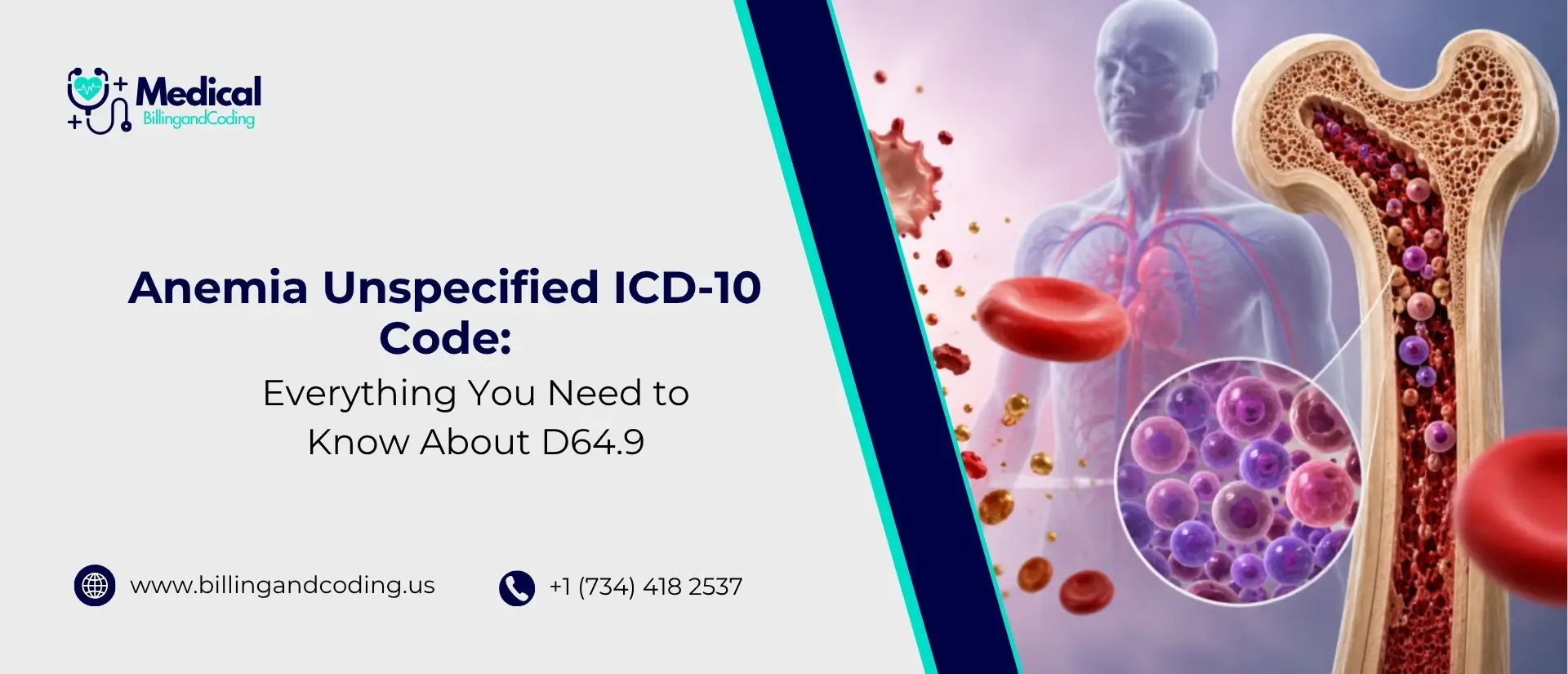
Anemia is one of the most commonly diagnosed blood disorders in clinical practice, yet it remains one of the most misunderstood. At its core, anemia occurs when the body doesn’t have enough healthy red blood cells to carry adequate oxygen to tissues. This seemingly simple definition, however, opens into a vast landscape of causes, presentations and subtypes that keep clinicians, coders and billers on their toes every single day.
According to the World Health Organization, anemia affects roughly 1.62 billion people globally. That’s nearly a quarter of the world’s population walking around with some degree of reduced oxygen-carrying capacity, whether they know it or not.
Introduction to Anemia Unspecified ICD-10 Code
Understanding Unspecified Anemia
Here’s where things get interesting from a documentation standpoint. Not every patient who walks in with low hemoglobin levels gets a clean, tidy diagnosis like iron deficiency anemia or vitamin B12 deficiency anemia. Sometimes the workup is incomplete. Sometimes test results are pending. Sometimes the clinical picture is genuinely ambiguous. In those situations, providers reach for the “unspecified” designation, which in ICD-10 language translates to D64.9.
Unspecified anemia isn’t a lazy diagnosis. It reflects real clinical uncertainty and the coding system is designed to accommodate that. What matters is that it’s used correctly and not as a default substitute for more precise coding when better information is actually available.
Why Accurate ICD-10 Coding Matters
Accurate ICD-10 coding is the backbone of medical billing, quality reporting and population health tracking. When a coder assigns D64.9 to a claim, that code communicates to payers, registries and downstream data systems that a patient was treated for anemia where the specific type couldn’t be determined. Get this wrong and you’re looking at claim denials, compliance risk and gaps in patient care data that ripple through the entire healthcare ecosystem.
What Is the ICD-10 Code for Unspecified Anemia?
ICD-10 Code D64.9 Explained
D64.9 is the ICD-10-CM code for “Other and unspecified anemias, unspecified.” It lives within the D60–D64 block of the ICD-10 classification system, which covers aplastic and other anemias and bone marrow failure syndromes. The “.9” at the end signals unspecified, meaning documentation doesn’t point to a more defined type.
This is a billable, valid diagnosis code that healthcare providers and medical billers use across inpatient, outpatient and emergency settings. It’s widely accepted by Medicare, Medicaid and most commercial payers, though as with any unspecified code, overuse can trigger payer scrutiny.
When to Use D64.9
D64.9 is appropriate in a few specific scenarios. First, when a patient presents with anemia but diagnostic workup hasn’t identified a clear underlying cause yet. Second, when the provider documents anemia without specifying the type in the clinical note. Third, when test results are pending at the time of the encounter and a more specific code cannot be supported by available documentation.
What D64.9 is not appropriate for is situations where the cause is known but the coder simply doesn’t look for the more specific code. If the chart clearly says “iron deficiency anemia,” coding D64.9 is a documentation mismatch that could flag an audit.
Conditions Included Under Unspecified Anemia
Under the umbrella of D64.9, you’ll find cases where anemia is noted as a finding but etiology isn’t established. This includes anemia in patients awaiting further evaluation, anemia documented broadly without subtype and cases where prior records indicate anemia but current notes don’t elaborate on its nature.
Causes and Symptoms of Unspecified Anemia
Common Causes of Anemia
Anemia doesn’t happen in a vacuum. It has causes and understanding them clinically helps providers eventually move from D64.9 to something more specific. The most frequent culprits include iron deficiency (often from chronic blood loss or inadequate intake), vitamin B12 or folate deficiency, chronic disease processes like kidney disease or rheumatoid arthritis, bone marrow disorders and hemolytic conditions where red cells are destroyed faster than they’re made.
In older adults, anemia of chronic inflammation is surprisingly common and often goes unnamed for longer than it should.
Signs and Symptoms to Watch For
Patients with anemia often describe fatigue so profound it interferes with daily function. Shortness of breath on exertion, pale skin, cold hands and feet, dizziness and headaches are all classic. In more severe cases, chest pain and rapid heartbeat push the urgency level considerably higher.
The tricky part is that many of these symptoms are nonspecific. They overlap with dozens of other conditions, which is exactly why some anemia cases land in the “unspecified” category initially. The symptoms don’t always point neatly to a cause.
Risk Factors Associated with Anemia
Women of childbearing age, pregnant individuals, young children, people with chronic illnesses, vegetarians and vegans who aren’t carefully managing their nutrition and older adults all carry elevated risk. Certain medications, including chemotherapy agents and some antibiotics, also affect red blood cell production and can tip susceptible patients into anemia.
Diagnostic Process for Unspecified Anemia
Laboratory Tests Used for Diagnosis
A complete blood count (CBC) is the starting point for any anemia workup. It gives you hemoglobin, hematocrit, red cell indices like MCV and MCH and a reticulocyte count. From there, additional labs like serum ferritin, iron studies, B12, folate, peripheral blood smear and in some cases bone marrow biopsy help narrow the diagnosis.
When a provider orders these tests but results aren’t back at the time of coding, D64.9 is the right placeholder.
Importance of Clinical Documentation
This point deserves emphasis. The quality of physician documentation is directly tied to coding accuracy. If the note says only “anemia present,” that’s D64.9 territory. If it says “anemia due to chronic kidney disease,” that changes everything, both the diagnosis code and the coding strategy.
Coders cannot infer or assume. They code what is documented. This is why strong provider education about specific language in clinical notes pays dividends at every stage of billing.
Differentiating Unspecified Anemia from Other Types
The ICD-10 system has highly specific codes for iron deficiency anemia (D50 series), vitamin deficiency anemias (D51–D53), hemolytic anemias (D55–D59), aplastic anemia (D60–D61) and others. Anytime documentation supports one of these specific categories, the more precise code should be used over D64.9. Specificity is always preferred in medical coding because it tells a more complete clinical story.
Medical Billing and Coding Guidelines for D64.9
Coding Requirements for Unspecified Anemia
D64.9 is straightforward to apply but must be supported by clinical documentation that references anemia without specifying type. Coders should follow official ICD-10-CM guidelines, review the Alphabetic Index and Tabular List for any instructional notes and check whether any “code first” or “use additional code” instructions apply when anemia is related to an underlying condition.
Documentation Needed to Support the Diagnosis
At minimum, the provider’s note must include a documented diagnosis of anemia. Supporting lab values (low hemoglobin or hematocrit) strengthen the claim significantly. If anemia is a secondary finding related to a primary condition. Both diagnoses should appear in the documentation and coded in appropriate sequence.
Common Coding Errors and How to Avoid Them
One of the most frequent mistakes is assigning D64.9 when a more specific code is supported by the record. Another is failing to link anemia to an underlying condition (like chronic kidney disease) when that relationship is clearly documented. Query workflows between coders and providers reduce these errors substantially.
Reimbursement Considerations for Anemia Claims
Insurance Coverage and Claim Processing
Most payers cover anemia diagnoses when medically necessary services are provided. D64.9 on its own is generally accepted, but claims pairing it with high-cost services or procedures may receive additional scrutiny. Prior authorization requirements vary by payer and service type.
Impact of Accurate Coding on Reimbursement
Correct coding protects reimbursement in two directions. Overly vague coding (defaulting to D64.9 when specifics are available) can trigger downcoding or denials from payers who expect more precise documentation for certain services. Undercoding the severity of anemia related to a complex condition can reduce appropriate reimbursement for resource-intensive care.
Tips for Reducing Claim Denials
Invest in coder education around anemia coding specificity. Build query templates for common ambiguous documentation patterns. Conduct periodic audits of D64.9 claims to ensure the code is being applied appropriately and not as a blanket fallback.
Related ICD-10 Codes for Anemia
Iron Deficiency Anemia Codes
D50.0 covers iron deficiency anemia secondary to blood loss. D50.8 and D50.9 address other and unspecified iron deficiency anemias. These codes are some of the most frequently used in the D50–D64 range.
Vitamin Deficiency Anemia Codes
D51 codes address vitamin B12 deficiency anemias. D52 covers folate deficiency anemia. D53 captures other nutritional anemias and including those related to protein or multiple nutritional deficiencies.
Other Specified and Unspecified Anemia Codes
D64.81 (anemia due to antineoplastic chemotherapy) and D64.89 (other specified anemias) offer more precision when documentation allows. D64.9 remains the last resort when no further specification is available or documented.
Best Practices for Healthcare Providers and Billers
Improving Documentation Accuracy
Providers should get comfortable documenting the type of anemia when it’s known and explicitly noting when it’s under evaluation. Phrases like “anemia, type to be determined pending labs” actually help coders tremendously. Clear cause-and-effect language (such as “anemia due to…” or “anemia in the setting of…”) enables more accurate code assignment downstream.
Staying Updated with ICD-10 Coding Changes
ICD-10-CM is updated annually, typically effective October 1st. Codes get added, revised and deleted. Coders and billers who don’t track these changes risk using invalid codes, which guarantees claim rejections. Subscribing to CMS update newsletters and participating in AHIMA or AAPC continuing education keeps teams current.
Ensuring Compliance in Medical Billing
Compliance in anemia coding means using the most specific code supported by documentation, sequencing codes correctly when anemia is secondary to another condition and maintaining audit trails. Organizations with robust compliance programs catch D64.9 overuse before it becomes a payer audit issue.
Conclusion
D64.9 serves an important and legitimate purpose in the ICD-10 coding system. It exists to capture real clinical uncertainty and when used correctly and it reflects honest, accurate coding. The problems arise when it becomes a habit rather than a careful choice.
Make An Appintment With Us